Fire Alarm Zones –
As commercial buildings in Ilkley become larger and more complex, effective fire alarm zoning becomes increasingly important. Many businesses focus heavily on detectors and sounders while overlooking the role that correctly designed zones play in helping occupants and emergency services respond quickly during an incident.
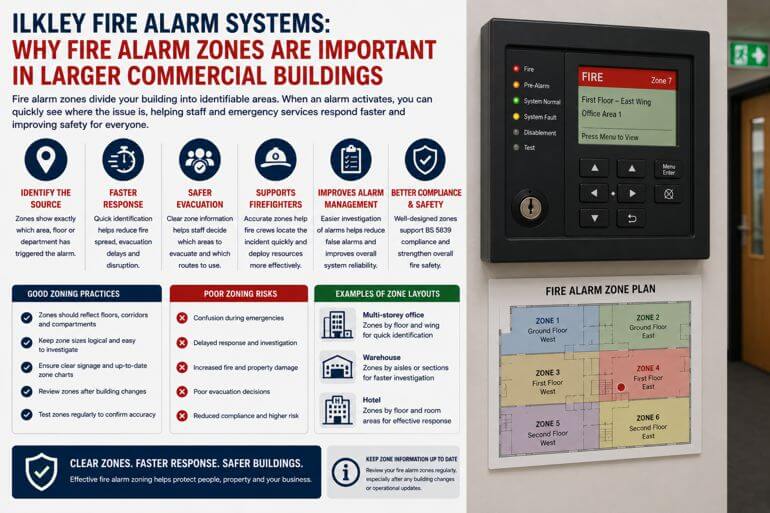
A fire alarm zone divides a building into identifiable sections so that when an alarm activates, staff and responding personnel can quickly determine the approximate location of the issue. Without clear zoning, even a modern fire alarm system can create confusion during an emergency.
Fire Alarm Zones Help Identify the Source of Activation
In smaller buildings, locating the source of an alarm may be straightforward. However, in larger premises such as:
- offices
- schools
- warehouses
- hotels
- industrial units
- and multi-floor commercial buildings
finding the activated detector or call point can become far more difficult.
Fire alarm zones allow systems to indicate:
- which floor
- corridor
- department
- or section of the building
has triggered the alarm.
Faster Response Can Reduce Fire Damage
When the affected area is identified quickly, staff or emergency services can:
- investigate faster
- confirm genuine emergencies sooner
- and respond more effectively
Early identification may help reduce:
- fire spread
- evacuation delays
- and operational disruption
For Ilkley commercial premises, this can significantly improve overall emergency management.
Zoning Supports Safer Evacuation
Clear zoning also improves evacuation procedures.
Instead of uncertainty about where the issue has occurred, responsible persons can understand:
- which area is affected
- whether phased evacuation may apply
- and which escape routes should remain clear
This is particularly important in:
- multi-storey buildings
- buildings with compartmentation
- or premises with large occupancy numbers
Firefighters Benefit from Accurate Zone Information
Attending fire crews rely heavily on fire alarm zone information during initial response.
Well-designed zones help emergency services:
- identify likely fire locations
- prioritise searches
- and deploy resources more effectively
Poorly labelled or confusing zoning can delay response times inside the building.
Zones Must Be Clearly Labelled
One of the most common problems found in commercial premises is poor zone identification.
Zone charts should be:
- accurate
- up to date
- easy to read
- and positioned near the fire alarm panel
In Ilkley businesses where layouts have changed over time, outdated zone plans can create serious confusion during emergencies.
Building Alterations Often Affect Zoning
Commercial premises regularly undergo changes such as:
- office reconfiguration
- partition wall installation
- extensions
- or changes in occupancy
These alterations can affect:
- detector coverage
- escape routes
- and zone boundaries
Systems should always be reviewed following major building changes.
Larger Buildings Require Structured Zone Design
Effective zoning is not random.
Zone layouts should consider:
- floor structure
- occupancy levels
- escape routes
- fire compartmentation
- and operational risks
Poorly designed zones can create oversized areas that are difficult to investigate efficiently.
False Alarms Become Easier to Investigate
Zones also assist with managing false alarms.
When the activation area is identified quickly, staff can:
- investigate more efficiently
- identify recurring problem areas
- and reduce unnecessary disruption
This is particularly valuable in buildings with:
- kitchens
- workshops
- dusty environments
- or changing environmental conditions
Fire Alarm Panels Depend on Accurate Information
Modern commercial fire alarm panels display:
- active zones
- fault locations
- disabled areas
- and alarm origins
However, these systems are only effective if the zone configuration is accurate and maintained properly.
Regular Testing Helps Verify Zone Accuracy
Routine fire alarm testing should confirm:
- zones activate correctly
- panel information matches building layouts
- and signage remains accurate
Weekly testing and professional servicing help maintain system reliability.
Staff Should Understand Basic Zone Information
Responsible persons should know:
- how to identify active zones
- how to read zone charts
- and how to communicate alarm locations clearly
This improves coordination during evacuations and investigations.
Fire Alarm Zoning Improves Overall Building Safety
For businesses in Ilkley, properly designed fire alarm zones help create:
- faster emergency response
- safer evacuation
- clearer alarm management
- and stronger compliance
As commercial premises become more complex, effective zoning is no longer just a technical feature — it is an essential part of reliable fire alarm design and emergency preparedness.
Frequently Asked Questions
What is a fire alarm zone?
A fire alarm zone is a defined section of a building used to identify where an alarm activation has occurred.
Why are zones important in large buildings?
Zones help staff and emergency services locate incidents faster and manage evacuation more effectively.
Should zone charts be updated after building changes?
Yes. Any layout alterations should trigger a review of zone plans and fire alarm configuration.