Aspirating Smoke Detection –
Certain commercial environments require fire detection systems capable of identifying smoke particles at an extremely early stage — often long before conventional detectors would activate. This is where aspirating smoke detection systems are becoming increasingly important.
Businesses across Ilkley are using aspirating detection technology within:
- server rooms
- data centres
- clean environments
- archives
- manufacturing areas
- and critical infrastructure spaces
where very early fire detection may help reduce:
- operational disruption
- equipment damage
- and business continuity risks.
What Is Aspirating Smoke Detection?
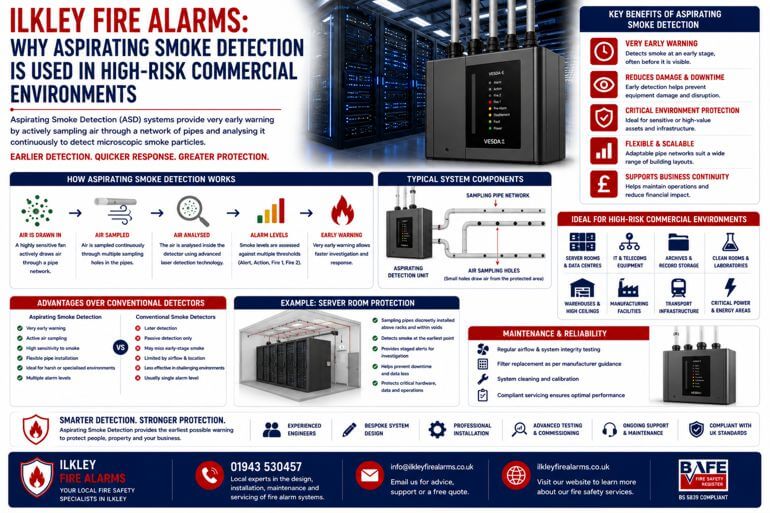
Unlike traditional ceiling-mounted detectors that passively wait for smoke to reach them, aspirating systems actively draw air samples through a network of pipes.
The sampled air is analysed continuously within a highly sensitive central detection unit.
This allows aspirating systems to identify:
- microscopic smoke particles
- overheating conditions
- and developing fire events
at a much earlier stage than many conventional systems.
Early Detection Can Reduce Business Impact
In environments containing:
- sensitive electronics
- valuable equipment
- or critical operations
even small amounts of smoke may create significant damage or downtime.
Very early warning allows businesses to:
- investigate issues faster
- isolate equipment
- and respond before conditions escalate
Server Rooms And IT Spaces Commonly Use Aspirating Systems
Modern server rooms often contain:
- high airflow
- cooling systems
- dense cabling
- and critical infrastructure
Traditional detectors may sometimes struggle within these environments because airflow can dilute or redirect smoke movement.
Aspirating systems help overcome this challenge through active air sampling.
Warehouses And High Ceilings Create Detection Challenges
Large commercial buildings with:
- high roofs
- open spaces
- or extensive racking
may experience delayed smoke movement toward conventional ceiling detectors.
Aspirating systems can provide:
- faster smoke identification
- more flexible pipe placement
- and improved coverage strategies
within larger spaces.
Clean Environments Require Sensitive Detection
Certain facilities such as:
- laboratories
- pharmaceutical environments
- and clean manufacturing spaces
require highly sensitive detection while maintaining controlled environmental conditions.
Aspirating systems can operate effectively in these specialised environments.
Multi-Level Warning Thresholds Improve Response Options
Many aspirating systems allow:
- staged warning levels
- investigation alerts
- and escalating alarm thresholds
This helps businesses create:
- earlier intervention opportunities
- controlled investigation procedures
- and tailored fire response strategies
Detection Pipes Can Be Installed Discreetly
Sampling pipes are often:
- compact
- discreet
- and highly flexible
allowing them to be installed within:
- ceiling voids
- cabinets
- server racks
- or architecturally sensitive areas
without affecting the appearance of the environment.
Maintenance And Testing Remain Important
Although aspirating systems provide advanced detection capabilities, they still require:
- regular servicing
- airflow testing
- filter maintenance
- and system calibration
to maintain reliable performance.
Different Environments Require Different Detection Approaches
Aspirating smoke detection is not necessary for every building.
Professional fire alarm design helps determine whether:
- conventional detection
- multi-sensor technology
- beam detection
- or aspirating systems
are most suitable for the environment.
Modern Commercial Buildings Need Smarter Detection Strategies
For businesses in Ilkley, protecting critical operations increasingly requires more advanced fire detection methods than traditional systems alone.
Aspirating smoke detection helps provide:
- earlier fire identification
- improved business continuity protection
- enhanced equipment protection
- and stronger life safety performance
As commercial buildings continue relying on increasingly sensitive technology and infrastructure, very early warning fire detection is becoming an increasingly valuable part of modern fire alarm system design.
Frequently Asked Questions
What is aspirating smoke detection?
It is a very early warning fire detection system that actively samples air through a pipe network.
Where are aspirating systems commonly used?
They are often used in server rooms, data centres, warehouses and critical infrastructure environments.
Are aspirating systems more sensitive than standard detectors?
Yes. They can often identify smoke particles much earlier than conventional fire detectors.